

Why the “First Language” Choice Defines Your Career in the Age of Autonomous Agents
The tech industry of 2026 is no longer obsessed with “learning to code”—it is obsessed with systems thinking. As we sit here in April 2026, the barrier to entry for building a “working” application has never been lower, thanks to advanced LLMs and autonomous coding agents. However, the cost of inefficiency and unreliability has never been higher.
In this landscape, two languages have emerged as the dual pillars of modern development. Python, the old king of accessibility, has reinvented itself for a multi-core world. Rust, the challenger that promised safety, has become the mandatory standard for infrastructure.
If you are standing at this crossroads, the choice you make isn’t just about curly braces vs. indentation. It’s about choosing your side in the evolving digital economy.
The Renaissance of Python (2024–2026)
The Death of the GIL and the Birth of “Fast” Python
For twenty years, Python carried a heavy burden: the Global Interpreter Lock (GIL). It was the “speed tax” we all paid for the sake of simplicity. But as we entered 2025 and now 2026, the transition to Python 3.13 and 3.14 has fundamentally changed the narrative.
With the stabilization of Free-Threaded Python, the language can finally utilize modern 64-core processors effectively without the clunky workarounds of the multiprocessing module.
Why Python 3.14 Changed Everything
In 2026, Python is no longer “the slow language.” With the integration of a Just-In-Time (JIT) compiler into the CPython core and the removal of the GIL, Python has seen performance leaps of 2x to 5x for CPU-bound tasks.
For a beginner, this means the “performance ceiling” that used to force developers to switch to C++ or Java has been raised significantly. You can now prototype a high-frequency trading bot or a real-time video processing AI entirely in Python, knowing that the language will scale with your hardware.
The Rust Hegemony
Why “Memory Safety” Became a Legal Requirement
If Python is the language of the people, Rust is the language of the foundation. In 2026, the conversation around Rust has shifted from “Is it too hard?” to “Can we afford not to use it?”
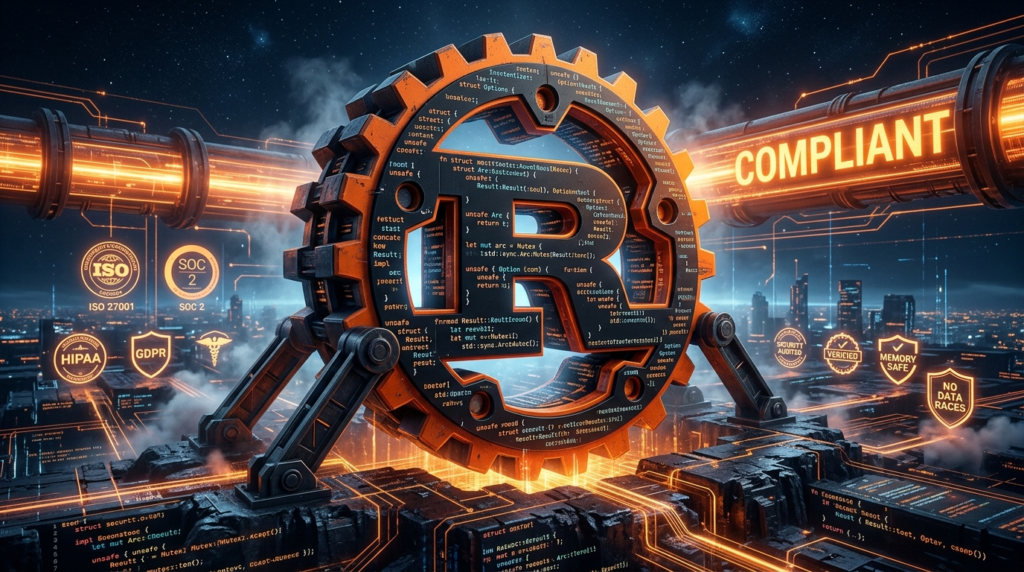
Following the 2024 white papers from the White House and CISA urging developers to move away from memory-unsafe languages (C/C++), Rust has become the “Gold Standard.” In 2026, if you are building medical software, aerospace systems, or financial kernels, using Rust isn’t just a preference—it’s often a compliance requirement.
The 2024 Edition and Beyond
The Rust 2024 Edition (stabilized in late 2025) focused on “Ergonomics.” The borrow checker—the infamous “final boss” of learning Rust—is now smarter. It understands intent better, reducing the “fighting the compiler” sessions that used to drive beginners away.
Rust in 2026 is the language of efficiency. As cloud costs have skyrocketed due to the massive energy demands of AI, companies are “Rewriting it in Rust” to cut their AWS bills by 40%. When you learn Rust, you aren’t just learning a language; you’re learning how to be a “Green Engineer” who saves companies millions in compute cycles.
The AI Factor
Learning to Code in the Age of Copilots
This is where the 2026 perspective differs from any article written in 2023. We must acknowledge that you will not be writing 100% of your code. You will be using AI agents.
Python: The AI’s Native Tongue
Python is the “training set” of the world. Because almost every AI library (PyTorch, TensorFlow, JAX) is written in or interfaced with Python, AI models are incredibly good at writing Python code.
- The Advantage: You can prompt an AI to build a complex data visualization, and it will give you perfect, idiomatic Python.
- The Trap: Because it’s so easy, beginners in 2026 often fall into the “Copy-Paste Trap,” where they understand what the code does but not why it works.
Rust: The AI’s Quality Control
AI is surprisingly good at Rust, but for a different reason. Rust’s strictness is an AI’s best friend. When an AI generates a Rust snippet, the compiler acts as a rigorous filter. If the AI hallucinates a memory leak, the compiler catches it.
- The Advantage: Learning Rust in 2026 teaches you to be a better Prompt Engineer. You have to be precise with your logic, or the compiler (and the AI) will call you out. Rust forces you to understand data ownership, a concept that makes you a better programmer in any language.
The Job Market of 2026
Breadth vs. Depth
Let’s talk money and careers. The 2026 job market has bifurcated into two distinct paths.
The Python Path: The “Generalist/Integrator”
Python developers today are often Product Engineers. They are the ones building the “Agentic Workflows”—connecting an LLM to a database, a web frontend, and a third-party API.
- Roles: AI Engineer, Data Scientist, Full-stack Integrator, DevOps Automation.
- The Vibe: High speed, high iteration. You ship features daily.
- Market Saturation: High. There are millions of Python devs. To stand out, you need domain expertise (e.g., Python + Finance or Python + Healthcare).
The Rust Path: The “Specialist/Systems Architect”
Rust developers are the Digital Blacksmiths. They build the high-performance engines that the Python devs use.
- Roles: Embedded Systems, Cloud Infrastructure, Game Engine Dev, Blockchain Security, WASM (WebAssembly) Developer.
- The Vibe: High precision, high stakes. You ship “perfect” code once a week.
- Market Saturation: Low. There is still a massive “Rust Gap.” Companies are desperate for people who can handle the complexity of systems-level programming.
Chapter 5: Head-to-Head Comparison (The 2026 Specs)
| Metric | Python (v3.15) | Rust (2024 Edition) |
| Startup Time | Fast (Improved with 2025 optimizations) | Instant (Compiled binary) |
| Concurrency | True parallel threads (Post-GIL) | Fearless concurrency (Zero-cost abstractions) |
| Memory Management | Automatic (Garbage Collected) | Manual but safe (Borrow Checker) |
| Package Management | uv / Poetry (Now standardized) | Cargo (Still the world’s best) |
| Web Presence | Django/FastAPI (Backend King) | Leptos/Dioxus (WASM-based Frontend) |
The Synergy – Why “Both” is the Real Answer
In 2026, the most elite developers don’t choose. They use PyO3.
The trend of 2026 is “Python for the API, Rust for the Logic.” You write your user-facing code and data shuffling in Python because it’s fast to write. When you find a function that is slowing down your app, you “drop into Rust,” write that specific module, and import it into Python as a high-speed library.
Learning Python first gives you the vision to see what’s possible.
Learning Rust second gives you the power to make it permanent.
The Verdict – Which Should You Learn First?
Scenario A: You want to build a startup or an AI application by next month.
Learn Python. The ecosystem is too big to ignore. Between LangChain, AutoGPT, and the endless stream of new AI wrappers, Python is the language of the “Now.” You can learn the basics in a weekend and be building functional tools by Monday.
Scenario B: You want to build a 20-year career in deep tech and infrastructure.
Learn Rust. It will be harder. You will cry at your monitor during the first two weeks. But once you “click” with the borrow checker, you will understand computer science at a level that 90% of Python developers never reach. You will be the person who gets hired when the Python app breaks under the weight of a million users.
Scenario C: The “Smart” 2026 Path (Recommended)
- Month 1: Learn Python. Build 3 simple AI-driven apps.
- Month 2: Learn how to optimize those apps.
- Month 3-6: Dive into Rust. Rewrite the “heavy” parts of your Python apps in Rust.
The Ethics of Code in 2026
As we look toward the end of the decade, the choice between Python and Rust reflects a deeper choice in our society. Python is about democratization—making sure everyone, from biologists to artists, can use the power of the computer. Rust is about stewardship—making sure the digital world we are building is stable, secure, and energy-efficient.
In 2026, the “best” language isn’t the one with the coolest syntax. It’s the one that helps you solve the problems you care about without breaking the world in the process.
Which world are you ready to build?


0 Comments