

They say that corporate life drains the color out of you, replacing the vibrant, chaotic hues of your youth with a predictable palette of beige cubicle dividers, gray carpets, and the harsh, unforgiving white of fluorescent lights. They tell you that a tech park is a machine, a sprawling expanse of glass and steel designed to extract code and productivity, leaving little room for anything as messy or unpredictable as human emotion.
But anyone who has actually spent years wandering the sprawling, manicured pathways of Infopark knows that this isn’t entirely true. A tech park is a city within a city. It is an ecosystem buzzing with thousands of lives, thousands of stories, and beneath the surface of daily stand-up meetings, sprint reviews, and deployment pipelines, it is a breeding ground for a very specific, very quiet kind of romance. It’s the kind of romance built not on grand gestures or cinematic encounters, but on the slow, intoxicating accumulation of shared routines.
I met her on my first day.
It was one of those suffocatingly humid mornings in Kakkanad, the kind where the air feels heavy enough to drink, long before the monsoon clouds finally decide to break. I was a bundle of nervous energy, suffocating in a formal shirt that felt too tight, clutching a temporary ID card that I kept checking to make sure I hadn’t lost. The induction room was a sea of unfamiliar faces, a room filled with fresh recruits and lateral hires, all of us trying to project an air of professional competence while internally panicking about where the restrooms were and how the coffee machine worked.
I was sitting in the second row, aggressively taking notes on the company’s HR policies—information I would immediately forget—when she walked in. She was running late, apologizing in a hushed whisper to the facilitator as she slipped into the only empty seat available, which happened to be right next to mine.
I want to be careful here, because memory has a way of turning people into mythology. I don’t want to describe her as some ethereal being who stopped time. She wasn’t the loudest person in the room. She wasn’t the kind of person who commanded immediate, overwhelming attention the second she crossed a threshold. She didn’t wear flashy clothes or have a booming laugh that demanded an audience.
Instead, she possessed a quiet, magnetic gravity. If some people are the firework that lights up a room with a sudden, blinding flash, she was the steady, warm glow of a lamp in a comfortable corner. She wasn’t the kind who’d light up a room—she was the light. It was a subtle radiance, the kind you only notice when you realize how cold and dim everything else feels when she isn’t there.
She settled into her chair, pulled out a notebook, and let out a tiny, exasperated sigh. She caught me looking, and instead of turning away, she offered a small, knowing smile, rolling her eyes slightly toward the presenter who was currently droning on about data compliance. In that single, fleeting micro-expression, the sterile corporate environment melted away. We were accomplices.
Over the next few weeks, our proximity in the seating arrangement blossomed into a tentative camaraderie. The initial awkwardness of “Hey, do you have the link to the timesheet portal?” evolved into “I am going to fall asleep if I have to look at this database schema for one more minute, please save me.”
Our interactions became the anchors of my workday. The 11:00 AM and 4:00 PM coffee breaks, initially polite obligations to stretch our legs, morphed into sacred rituals. We would leave the freezing, over-air-conditioned bays and walk down to the cafeteria. The coffee there was objectively terrible—a watery, overly sweet concoction dispensed from a machine that always sounded like it was dying—but I drank it like it was an elixir, simply because drinking it meant standing next to her for fifteen minutes.
Soon, the fifteen-minute coffee breaks weren’t enough. They stretched into lunch walks. Infopark is massive, a labyrinth of interconnected buildings, paved walkways, and small patches of aggressively maintained greenery. We would walk along the perimeter, the roar of the traffic from the expressway a distant hum, insulated in our own little bubble of conversation.
We talked about everything and nothing. We talked about the music we listened to when we were pretending to work (she loved obscure indie folk; I was partial to instrumental soundtracks). We talked about our childhoods, the strange quirks of our families, the places we wanted to travel to when our bank accounts finally allowed it. We bonded over a mutual, deep-seated hatred for Mondays—not just the day itself, but the specific, creeping existential dread that settles in your chest around 6:00 PM on a Sunday evening.
“It’s like the weekend is a lie,” she told me once, kicking a pebble across the pavement. “You blink on Friday evening, and suddenly your alarm is screaming at you on Monday morning, and you have to put the corporate mask back on.”
“We should start a petition,” I joked. “Cancel Mondays. Move straight to Tuesdays. Tuesdays have lower expectations.”
She laughed, a genuine, unrestrained sound that made the sweltering afternoon heat feel a little less oppressive. It was a laugh I would eventually start listening for over the clatter of keyboards in the office bay, a sound that instantly recalibrated my mood.
As the months bled into one another, the boundary between “work friends” and “actual friends” dissolved completely. The conversations that began in the physical confines of the tech park soon spilled over into the digital realm. It started innocently enough—a forwarded meme about software testing, a complaint about a difficult client. But then, the timing shifted.
The messages started arriving later. 10:00 PM. 11:30 PM. Midnight.
“Are you still awake?” Her name would light up on my phone screen in the dark of my bedroom, and a jolt of electricity would shoot through my chest. I could be dead tired, my eyes burning from staring at monitors all day, but the moment that notification chimed, I was wide awake.
We would text for hours, the glowing screen the only light in the room. We talked about our fears, our insecurities, the imposter syndrome that haunted both of us in our careers. We built a shared universe of inside jokes, a secret language comprised of emojis and truncated sentences that no one else in the world would understand. In the quiet intimacy of those late-night texts, the armor we wore during the day fell away entirely.
Somewhere in the midst of all this—somewhere between the watery cafeteria coffee, the complaints about Monday mornings, and the glowing 1:00 AM text messages—I realized I was in deep trouble.
I didn’t just enjoy her company; I required it. She had become the lens through which I viewed my entire day. If something funny happened on my commute, my first instinct wasn’t to laugh, but to think about how I would describe it to her later to make her laugh. If I was having a terrible day, the only thing that kept me tethered was the knowledge that I would see her at 4:00 PM by the coffee machine.
I had fallen. It wasn’t a sudden trip, but a slow, gradual descent, like sinking into warm water until it was over my head.
And then, June arrived, bringing with it the relentless fury of the Kerala monsoon.
The monsoon transforms the tech park. The bright, glaring concrete turns dark and slick. The sky becomes a permanent ceiling of bruised, slate-gray clouds. The air smells heavily of ozone, wet earth, and the exhaust of a thousand cabs idling at the security gates.
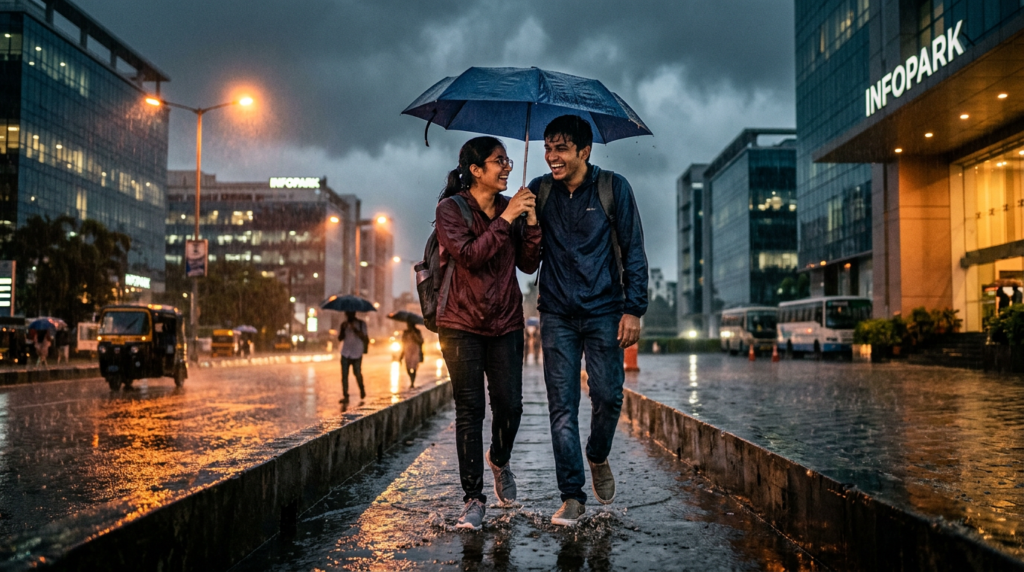
One particular evening, the heavens opened up with apocalyptic intensity just as we were leaving our building. The wind was howling, driving the rain sideways in sheets. Neither of us had checked the forecast, but she had a small, flimsy folding umbrella tucked into her tote bag.
“We’ll have to share,” she shouted over the deafening roar of the rain hitting the pavement. “My cab is waiting near the main gate.”
I popped the umbrella open. It was woefully inadequate for the two of us, let alone the storm. To stay under its meager canopy, we had to press close together. As we waded through the ankle-deep water rushing across the walkways, my arm brushed against her shoulder. The physical proximity was dizzying. I could smell the faint trace of jasmine in her hair, mixed with the sharp, metallic scent of the rain. We were huddled together, a tiny island of warmth moving through the chaotic deluge, laughing as our shoes soaked through.
When we finally reached her cab, we were both drenched despite the umbrella. She turned to me, her hair plastered to her forehead, mascara slightly smudged beneath her eyes, and she looked so incredibly, breathtakingly beautiful that it physically hurt to look at her.
“Thanks for the escort,” she smiled, her eyes crinkling at the corners.
“Anytime,” I managed to say, my voice sounding tight and unfamiliar in my own ears.
I watched her cab disappear into the curtain of rain, standing alone by the gate, completely soaked, with a heart hammering so wildly against my ribs I thought it might crack them. That was the moment I knew I couldn’t keep it to myself anymore. The secret was getting too heavy to carry. It was bleeding into my work, my sleep, my every waking thought. I had to tell her. I convinced myself that the late-night texts, the shared glances during meetings, the comfort of the shared umbrella—they all meant something. They had to mean something.
I planned it a hundred times in my head. I scripted it, revised it, rehearsed it in the mirror. But reality rarely adheres to a script.
It happened on another monsoon evening, a few weeks later. We were both working late, the office largely deserted save for a few unfortunate souls stuck on a critical deployment. The hum of the servers seemed louder in the empty bays. Around 7:30 PM, the hunger and the screen fatigue became unbearable, and we walked down to the cafeteria together.
The food court was empty, the chairs stacked on tables, the vendors having closed up shop hours ago. Only a single counter remained open, illuminated by a harsh yellow bulb. We grabbed two coffees—she got her usual cold coffee, clutching the condensation-beaded plastic cup—and walked over to the massive glass wall that looked out over the tech park campus.
Outside, the rain was falling in thick, heavy ropes, illuminated by the orange glow of the streetlights. We stood side by side, watching the raindrops race each other down the massive pane of glass, leaving erratic, watery trails in their wake.
“It’s beautiful, isn’t it?” she murmured, her breath fogging the glass slightly. “In a chaotic, messy sort of way.”
I wasn’t looking at the rain. I was looking at her profile, illuminated softly by the ambient light of the empty cafeteria.
“Yeah,” I breathed. “It is.”
The silence stretched between us. It wasn’t our usual comfortable silence; it was heavy, pregnant with the weight of the words I was holding back. My hands were freezing, completely devoid of blood, but my palms were sweating. My chest felt tight, the air suddenly too thick to breathe. My heart was beating with such violent intensity I was certain it was louder than the thunder rolling across the sky outside.
Do it now, my brain screamed. Just say it.
“Listen,” I started. My voice cracked. I cleared my throat and tried again, turning to face her fully. “There’s something I need to tell you.”
She turned from the glass, taking a sip from her cold coffee, her expression open and curious. “What’s up? You look terrified. Did you drop the production database?”
I let out a weak, breathy laugh that contained absolutely no humor. “No. No, it’s not work.” I swallowed hard, feeling the dry scrape of my throat. “It’s about us.”
The moment the word ‘us’ left my mouth, I saw a microscopic shift in her posture. The relaxed, leaning stance tightened. The casual curiosity in her eyes flickered into something sharper, something cautious. But I was already in freefall; there was no pulling the parachute now.
“These past few months,” I plowed on, the rehearsed script entirely forgotten, relying solely on the panicked adrenaline rushing through my veins. “Getting to know you… it’s been the best part of being here. It’s the best part of my day. And I know we’re friends, and I value that more than anything, but… I can’t just be your friend anymore. I think about you all the time. I’ve fallen for you. Completely.”
The words hung in the empty cafeteria, fragile and terrifying, suspended in the air between us. I waited for the magical movie moment. I waited for her eyes to widen with realization, for the coffee cup to slip from her hands, for her to tell me she felt exactly the same way.
Instead, she just looked at me.
She didn’t look horrified, or disgusted, or even particularly surprised. And that, in a way, was the worst part.
Slowly, she smiled.
But it wasn’t the smile I wanted. It wasn’t the smile she gave me when we joked about Mondays, or the smile from the rain under the umbrella. It wasn’t the smile that lit up the room.
It was a heavy, sinking thing. It was just a soft, immensely apologetic smile. It was the smile of someone who is about to break something they care about, and wishes they didn’t have to.
“Oh,” she whispered. She looked down at her plastic cup, her thumb tracing the rim. The silence stretched out again, agonizingly long this time. I felt the absolute certainty of my rejection settle into my stomach like a block of ice before she even spoke the words.
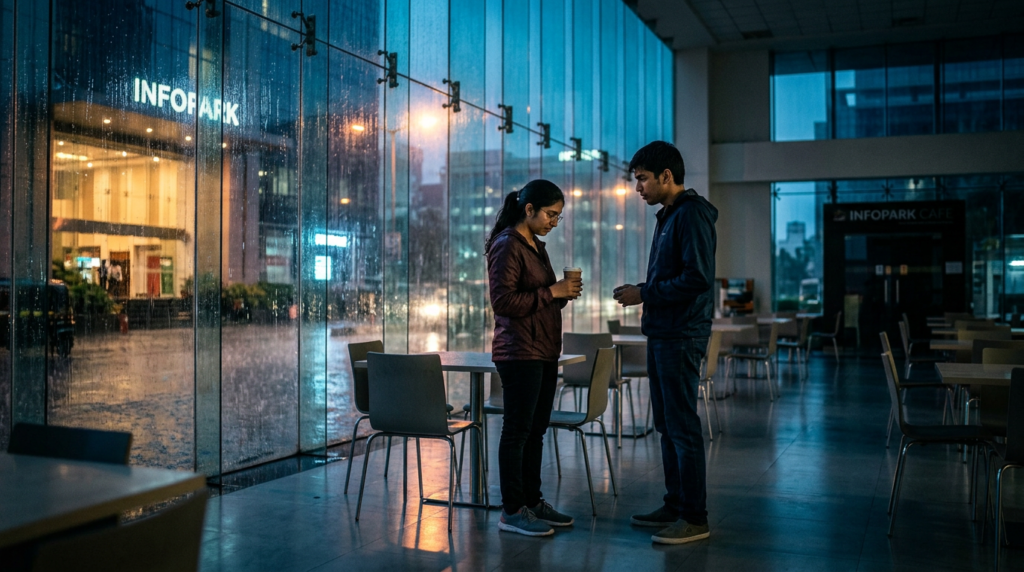
When she finally looked back up at me, her eyes were swimming with a genuine, painful sadness.
“You are such a good person,” she said softly, her voice barely carrying over the ambient hum of the refrigerators. “You are one of the best friends I have here. I love our talks, I love our walks. But…” She took a shallow breath, holding my gaze even though it clearly pained her. “…I don’t see you that way. I’m so sorry. You’re a good friend… but no.”
There it was. The guillotine dropping. Clean, efficient, and final.
I don’t remember much of the immediate aftermath. I remember the overwhelming rush of blood to my ears, a flush of deep, burning embarrassment creeping up my neck. I remember forcing a smile onto my face—a rigid, painful mask—and waving my hands dismissively, as if I had just offered her a piece of gum and she had politely declined.
“Hey, it’s okay,” I lied, my voice sounding hollow and metallic. “Don’t worry about it. I just… I had to put it out there. Forget I said anything. We’re good.”
“Are you sure?” she asked, stepping slightly closer, her brow furrowed with concern. “I really don’t want things to be weird between us.”
“Not weird at all,” I lied again, stepping back to maintain the distance. “I’m going to head back up. Need to finish that script. I’ll catch you later.”
I walked away from the glass wall, away from her, and back to the sterile safety of my cubicle. I sat staring at the glowing lines of code on my monitor for three hours, not comprehending a single character, feeling as though a vital organ had been cleanly surgically removed without anesthesia.
That was two years ago.
We tried to maintain the friendship, of course. People always say they will. But once you introduce the specter of unrequited love into a platonic relationship, the architecture of it fundamentally changes. The late-night texts stopped entirely. The lunch walks became infrequent, filled with polite, stilted conversations about the weather or management changes, carefully avoiding any topic that felt too personal, too intimate. The comfortable silence we used to share was replaced by a deafening, awkward quiet.
She left the company last year.
She got a better offer in another city. We had a team farewell lunch for her at a restaurant just outside the Infopark gates. I chipped in for the cake, signed the oversized greeting card with a generic “Wishing you the best in your future endeavors,” and stood at the back of the group photo. When it was time for her to leave, she gave me a brief, one-armed hug.
“Keep in touch,” she said, offering me that same soft, apologetic smile one last time.
“You too,” I replied.
We haven’t spoken since.
Life at Infopark goes on. The tech park doesn’t care about broken hearts. Projects are delivered, sprints are closed, new batches of freshers arrive looking terrified in their stiff formal wear. The machine keeps turning.
I’m still here. I got a promotion, moved to a different bay, and sit with a new team. I have a new routine now.
But I still walk past that spot near the cafeteria glass wall every day. I try not to look, but my eyes are drawn to it by sheer muscle memory. Sometimes, when the vendors are out of my usual filter coffee, I still order her favorite cold coffee—even though I despise how sweet it is—just to feel the condensation on the plastic cup.
And on the days when the monsoon returns, when the sky turns slate-gray and the rain hammers against the glass towers of the campus, I can close my eyes and, for a fleeting second, I can still hear her laugh echoing over the roar of the water.
People talk about moving on as if it’s a destination, a geographical location you finally reach after a long, arduous journey. They talk about closure as if every relationship requires a neatly tied bow. But I’ve learned that closure is a myth invented by screenwriters.
I have moved on. I date, I work, I live my life. The agonizing, sharp pain in my chest has faded into a dull, manageable ache. But I haven’t really left it behind. Not completely.
Because some love stories don’t get the dignity of an ending. They don’t explode in a fiery climax, and they don’t conclude with a warm embrace. They don’t end—they just stay unfinished. They become ghosts that haunt the mundane spaces of our lives. They settle into the background architecture of our minds, playing quietly like a radio left on in an empty room, a perpetual reminder of a beautiful, painful ‘almost’.
— Just another guy carrying memories in Infopark.


0 Comments